Uganda Launches First Locally Manufactured Diagnostic Test Kits
Kampala: 02/04/2026.
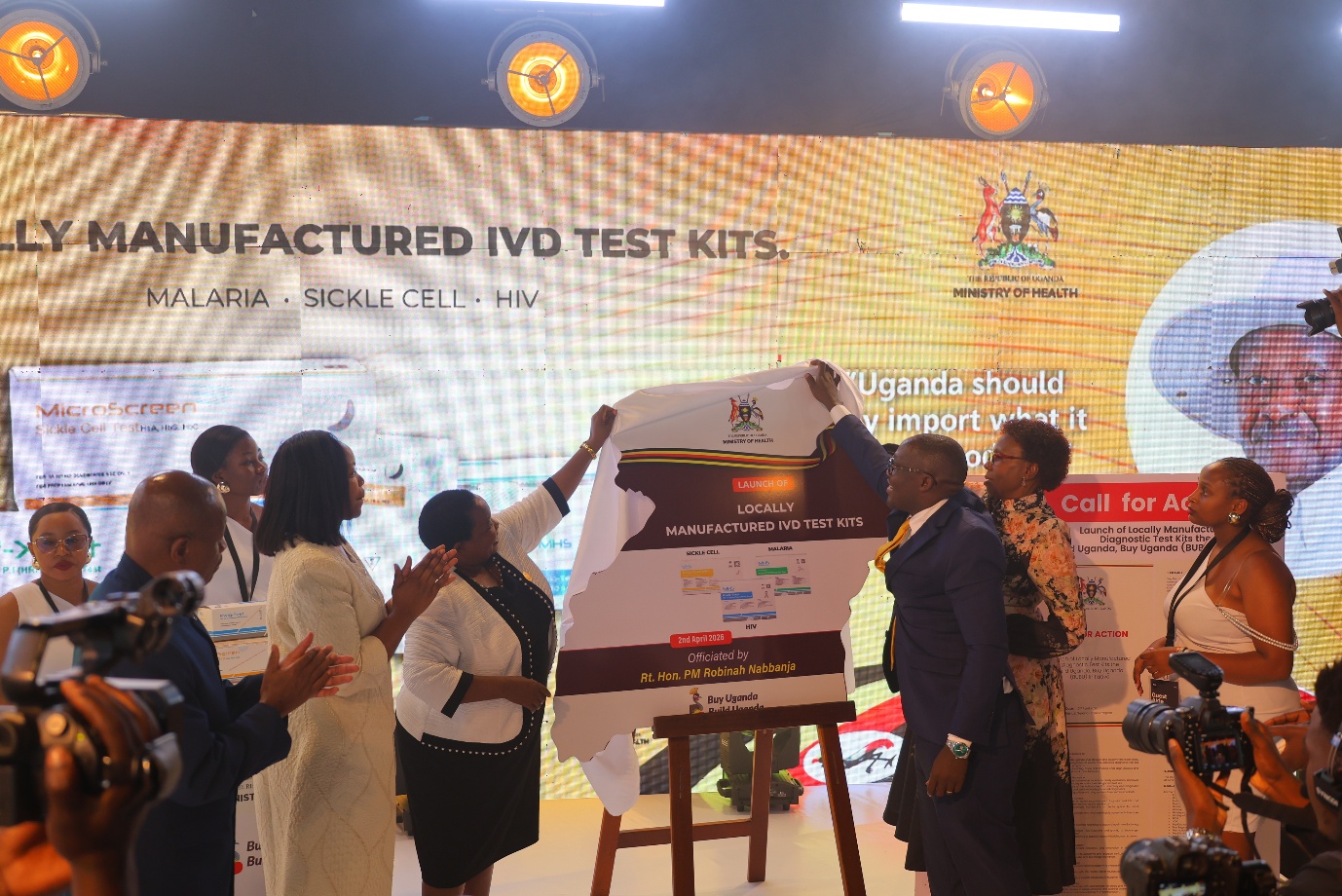
Uganda has taken a bold step toward health self-reliance with the launch of its first locally manufactured diagnostic test kits for malaria, HIV, and sickle cell disease.
The milestone event was presided over by the Prime Minister Rt. Hon. Robinah Nabbanja and brought together key government officials including Minister of Health Dr. Jane Ruth Aceng, State Minister for Trade Gen. Wilson Mbadi, Ministry of Health Permanent Secretary Dr. Diana Atwine, Director General of Health Services Dr. Charles Olaro, and representatives from the Ministry of Finance, the National Drug Authority private sector, civil society and health officials from various departments at national, regional and district level.
Manufactured by Microhaem Scientifics under the Buy Uganda, Build Uganda (BUBU) initiative, the kits mark a significant turning point in the country’s healthcare and industrial landscape. In her keynote address, Rt. Hon. Nabbanja described the development as a defining moment for Uganda.
“Uganda is making a turning point from dependency to self-reliance, from importation to production, from vulnerability to thriving. This is in line with President Museveni’s vision that Uganda should only import what it cannot locally manufacture.”
She emphasized the urgent need for collective action to support local innovations.
“75% of the disease burden in Uganda is preventable. I therefore call to action: Government should prioritize locally produced goods; support and trust local solutions; the private sector must continue investing in quality innovations; and healthcare workers should use and promote locally manufactured diagnostic tools.”
The Prime Minister also signed a Call to Action under the BUBU policy, outlining key resolutions to guide the integration of locally manufactured diagnostic kits into national health programs. These include;
Strengthening regulatory and quality assurance systems,
Prioritizing procurement of local commodities,
Mobilizing financing,
Building innovation capacity,
Establishing a multi-sectoral coordination platform, and
Developing a roadmap for monitoring and accountability.
Minister of Health Dr. Jane Ruth Aceng underscored the broader impact of local production on healthcare access and resilience.
“Having locally manufactured diagnostic commodities will ensure every Ugandan is tested and reduce the risks associated with reliance on imports. The biggest task now is to secure markets for our products across Africa. I urge manufacturers to safeguard quality; it is non-negotiable and health professionals to fully adopt and confidently use these kits. Uganda is ready to build, innovate, and take charge of its health future.”
State Minister for Trade and Cooperatives Gen. Wilson Mbadi highlighted the economic competitiveness of the locally produced kits.
“Locally produced kits cost USD 0.6, while imported ones cost USD 1.5. We are therefore well positioned to compete in regional and international markets such as COMESA, AfCFTA, and the EAC, with a combined GDP of USD 3.4 trillion.”
He stressed that maintaining quality and adherence to international standards will be critical to sustaining this competitive edge.
For Microhaem Scientifics, the moment signals both achievement and ambition. Managing Director Dr. Cedric Akwesigye expressed pride in leading the initiative and outlined the company’s production capacity and expansion plans.
“I am so excited to be at the helm of the first diagnostic production in Uganda to change the testing algorithm for HIV. Uganda is the first country in Africa to use locally manufactured kits. We have the capacity to produce 15 million kits monthly, 180 million annually serving Uganda and East Africa. By 2027, a planned facility will be able to cover the rest of Africa.”
The diagnostic kits have undergone rigorous validation by the Uganda Virus Research Institute and the National Health Laboratory and Diagnostic Services and have been certified by the National Drug Authority.